
Logeshwaran T

Software Engineer · Bengaluru, India

I build software that solves real problems.

I'm a software engineer in Bengaluru. At work I build admissions platforms on AWS used by 18 colleges. In my own time I built VibePit, a Mac app with a voice assistant that keeps all my Claude Code sessions in one window.

How I engineer products

From understanding the problem to running reliable software in production.

01. Understand

Start with the problem

Understand users, constraints, business goals, and system requirements before choosing a solution.

The VibePit app on macOS. The left side lists projects and Claude Code sessions, with route-map marked 'waiting for you'. Claude's plan is open for approval in the chat and as a document on the right.
This is VibePit. The left side lists every Claude Code session I have open, and the one waiting on me is highlighted. More about it

VibePit

VibePit is a free Mac app for anyone running several Claude Code sessions at once. It puts every session in one window, flags the one that's waiting on you, and lets you answer with a click.

It also has a voice assistant. That part started as a separate project of mine called Jarvis. Say "Hey Pit, open" and a project name to start working, and it tells you out loud when a session finishes or needs input.

The source code is private. I'm happy to walk through it in an interview.

Role
Designed and built it on my own
Runs on
macOS 12 or later, Apple silicon and Intel
Current version
1.1.0, free to download
Tests
458 automated tests
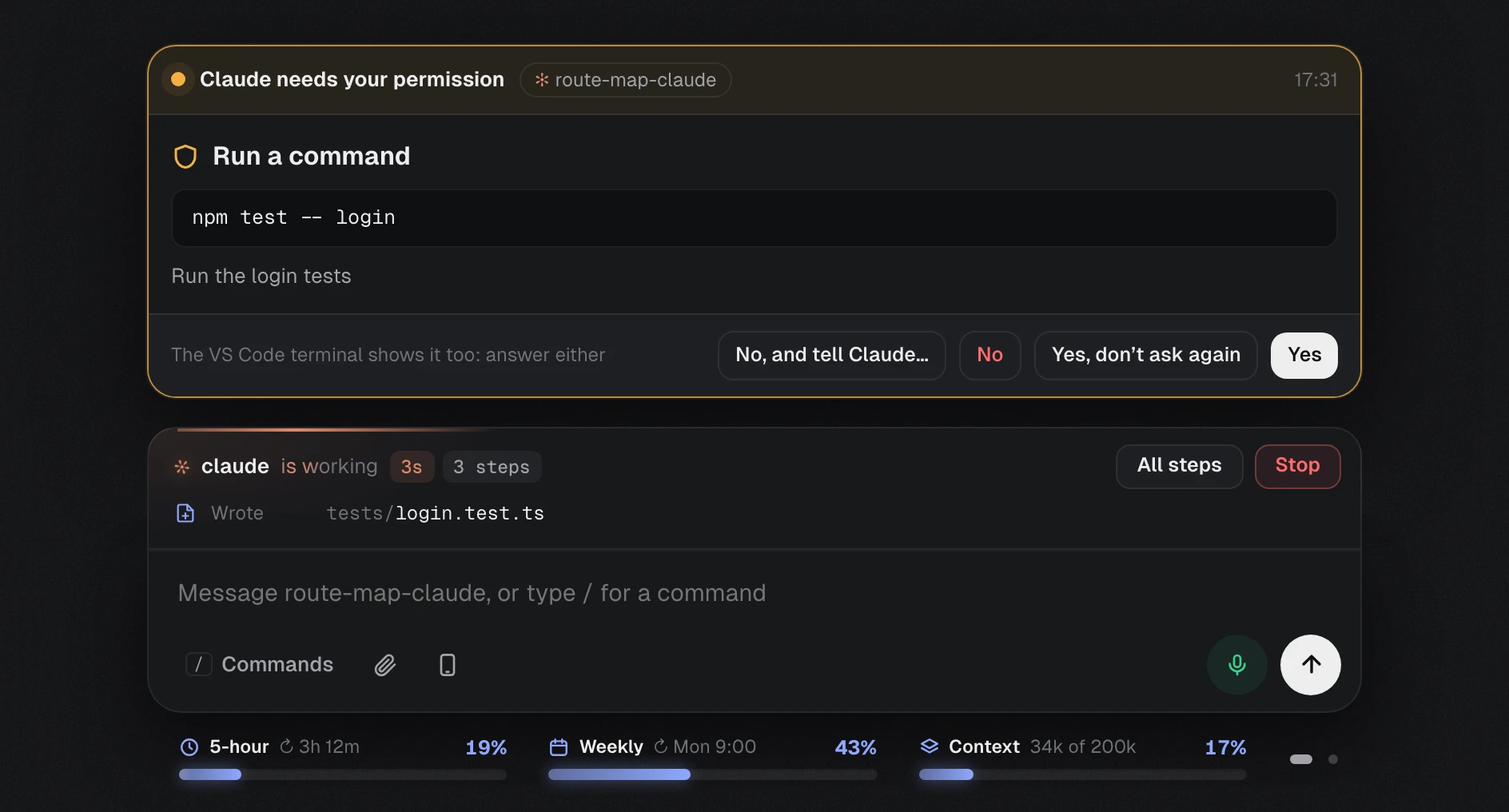
A VibePit permission card asking to run 'npm test -- login', with Yes, No and 'Yes, don't ask again' buttons, above a live 'claude is working' card.

When Claude wants to run a command, you get a card with real buttons. You can answer it from the app, from VS Code or from your phone.

Why I built it

I usually have several Claude Code sessions going across different projects, each in its own terminal. The one that needs me is always the one I'm not looking at. A session can sit on a permission prompt I never saw, plans scroll past as plain text, and when Claude asks me to run a command I don't always know what it will do.

I was spending more time finding the right terminal than answering Claude, so I built something for it.

What I did

  • It's a solo project. I came up with it, designed it, wrote the code and made the website.
  • The Mac app is Swift and AppKit. The interface is HTML served by a small Python server that runs locally.
  • I wrote the Claude Code hooks, a VS Code extension that opens and controls Claude terminals, and the phone link.
  • The voice side began as Jarvis, an assistant I built first. I merged it into VibePit: wake word, speech to text on the Mac, voice commands and spoken updates.
  • Version 1.1.0 added task and notes boards, a Microsoft Teams integration and a new usage meter.

How it works

It's built on Claude Code's hooks

When Claude asks a question or wants permission, a hook puts it in a local queue. The app, VS Code, voice or the phone can answer, and the first answer wins. Live progress comes from Claude Code's own transcript files.

A native shell with a web UI inside

Swift handles the window, the menu bar icon and a small panel that stays on top of full-screen apps. Everything else is HTML, so I can change the UI quickly and reuse it on the phone.

Nothing leaves your Mac

The server only listens on 127.0.0.1 and every request needs a secret token. There's no account and no analytics. The only thing it asks the internet is whether an update is out.

Phone pairing with one-time codes

Each code works once, and only after you press Allow on the Mac. Codes are stored hashed. The phone connects over Wi-Fi, or through an encrypted tunnel when you're away.

Speech is transcribed on the device

A wake word starts listening and Whisper turns speech into text on the Mac. Voice commands open VS Code, project repos and named Claude Code terminals.

It speaks up when a session is done

Claude Code's Stop and Notification hooks trigger a spoken message saying which terminal finished or needs input. The Mac stays awake during long runs.

Built with

Swift, AppKit, WKWebView, Python, JavaScript, HTML and CSS, Claude Code hooks, Whisper, AppleScript, VS Code extension API, Cloudflare Tunnel, pytest

Experience

Where I've worked and what I built there.

Incresco Technology Solutions

Software Development Engineer I

Mar 2024 to now

I work on the systems behind admissions at Global University Systems, a network of 30+ higher-education institutions across the UK, Europe, Canada and Asia.

Online Application Portal

One codebase for 18 colleges

Launching a new college's application form went from 6 months to 1 week.

  • Rebuilt the portal as a single Next.js and NestJS app. Forms and validation rules come from JSON Schema stored in DynamoDB, so adding a field is a data change and doesn't need a release.
  • Submissions go through SNS, SQS and a middleware layer into Salesforce asynchronously, with no duplicate records.
  • Added OCR checks for passports, IELTS, TOEFL and PTE certificates and transcripts. Each reviewer now gets through 15 to 20 applications a week instead of 10.
  • When a submission, a Salesforce sync or a DynamoDB write fails, the team gets an alert in Microsoft Teams through CloudWatch, SNS and webhooks.

Stack: Next.js, NestJS, DynamoDB, SNS, SQS, Salesforce, OCR

AppHero

Where students and agents track their applications

Helped bring review time for AppHero applicants down from 18 days to 10.

  • Built the portal where students and agents follow every application across GUS colleges, reply to the review team, upload documents and download offer letters.
  • In-app and email notifications run on AWS AppSync, triggered by Salesforce Platform Events.
  • Cut API response times by 30% and backend processing overhead by 25% with async processing, query tuning, caching at several layers and simpler orchestration.
  • Embedded the application portal inside AppHero using an iframe and window messages, and added a lock so two people can't edit the same application at once.

Stack: React, Node.js, AWS AppSync, Salesforce Platform Events

Integrations and data sync

Salesforce, partner CRMs and an Aurora cache

  • Event-driven sync from GUS Salesforce to partner CRMs such as Ellucian. It sends only the fields an event changed, retries every hour up to 4 times, then alerts an admin. Admissions staff no longer import data by hand.
  • A cache that copies Salesforce lookup data into Aurora PostgreSQL to save API calls. An ECS task fetches the data, SQS and Lambda write it, EventBridge Scheduler starts each sync, and only failed chunks are retried.

Stack: Salesforce, Ellucian, ECS, SQS, Lambda, Aurora PostgreSQL, EventBridge

HaushaltFee

Workforce platform for household employees

My cost plan projects AWS spend falling about 55%, from CHF 544 a month to about CHF 246, under the contract's CHF 300 cap.

  • Went through the production AWS account with Cost Explorer and CloudWatch. 76% of CI builds came from feature branches, so the plan limits CI to dev and main. It also clears old ECR images, merges 4 load balancers into 2, right-sizes Fargate and RDS, turns dev off at night, and adds AWS WAF and private databases.
  • Set up the Turborepo monorepo (Next.js, Prisma, PostgreSQL, pg-boss) with smoke tests and Playwright end-to-end tests.
  • Shipped a React Native app with native iOS and Android builds for scheduling, GPS attendance, leave, expenses and offline use. Changes made offline sync to PostgreSQL when the phone reconnects.

Stack: AWS, Fargate, RDS, WAF, Turborepo, Playwright, React Native, PostgreSQL

KitKat Software Technologies

MERN Stack Developer Intern

Apr 2023 to Mar 2024

  • Built React components and REST APIs that several product modules went on to use.
  • Fixed production bugs by debugging and reading logs.

Other projects

Things I've built outside my job, including one freelance client.

  • AI HR Operations Employee

    Personal project

    An AI agent for HR back-office work. You type something like "onboard a new SDE 1 in Bangalore, reporting to Rahul". It asks for anything missing, plans the steps and carries them out through typed tools that check permissions.

    • Every write has a risk level. Medium and high risk steps stop and show a before and after card that you can approve, reject or edit.
    • The agent acts with the signed-in user's token. Permissions and business rules live in the NestJS API, so they're enforced outside the model.
    • Policy answers come from RAG over pgvector with heading-aware chunking and reranking, and the UI shows the cited passages. A red-team eval set and 340+ pytest tests run in CI.

    Stack: LangGraph, FastAPI, NestJS, Next.js, PostgreSQL with pgvector

  • KnowledgeMesh

    Personal project

    A multi-tenant RAG app. Each workspace uploads its own documents and chats with them, and every answer cites its source.

    • Uploads go through a retry-safe Inngest pipeline that chunks, embeds and indexes them into Qdrant, with live status for each document.
    • Answers stream token by token over Server-Sent Events from tenant-filtered MMR search.
    • Every Postgres query and Qdrant search is filtered by tenant, and I checked that in production with two workspaces. Groq or OpenRouter can be swapped in through config.

    Stack: FastAPI, Next.js, Inngest, Qdrant, Neon Postgres

  • Viveka Technology

    Freelance

    Website and admin CMS for a FASTag service provider with toll-plaza branches in Tamil Nadu.

    • The owner edits any section and publishes without a redeploy. Changes go through save, preview and publish, with version backups and Zod validation.
    • SEO setup with a sitemap, canonical URLs, LocalBusiness and FAQ structured data, a page for each branch, and an IndexNow ping on every publish.
    • I'm now building a paid vehicle registration (RC) download service, with Cashfree payments confirmed by webhook.

    Stack: Next.js, TypeScript, Drizzle, Neon Postgres, Netlify

Skills

Only what I've used at work or in something I shipped.

Frontend

Daily at work, plus a React Native app with native iOS and Android builds.

React, Next.js, React Native, Expo, TypeScript, Tailwind CSS, TanStack Query

Backend

Daily at work. FastAPI for the Python side of my AI projects.

Node.js, NestJS, Express, FastAPI, PostgreSQL, DynamoDB, Prisma, GraphQL

Cloud and infrastructure

Mostly AWS. Event-driven setups with SNS, SQS and EventBridge, and one full cost audit.

Lambda, ECS Fargate, RDS and Aurora, SNS and SQS, EventBridge, AppSync, Terraform, Docker, GitHub Actions

AI

From my own projects: agents with approval steps, RAG and on-device speech.

LangGraph, Tool calling, RAG, pgvector, Qdrant, Whisper, OpenAI, Anthropic Claude, Gemini

Testing and tooling

Tests in CI, monorepos, and a lot of Claude Code.

Jest, pytest, Playwright, Claude Code hooks and MCP, Turborepo, Git

About me

I'm Logesh. I studied IT at Velalar College of Engineering and Technology, graduating in 2024, and started out as a MERN intern at KitKat Software in 2023. Since March 2024 I've been at Incresco, building admissions platforms and Salesforce integrations for Global University Systems.

What I like most is taking something vague and getting it to the point where people use it every day. At work that meant turning a six-month form build into a one-week setup. On my own it meant VibePit, which started because I kept losing track of my own Claude Code sessions.

I'm looking for a team where engineers own a problem from start to finish, ideally at a product company or an early-stage startup.

Get in touch

If you're hiring, or you'd like to talk about VibePit, email me or use the form.

Send a message

This sends me an email.